

As your business grows, so does the complexity of managing HR, payroll, and compliance. That’s why many companies turn to Professional Employer Organizations (PEOs) to handle the heavy lifting. But not all PEOs are created equal.
Enter the Certified PEO (CPEO, a designation backed by the IRS that adds an extra layer of security, accountability, and peace of mind.
In this article, we’ll break down the key differences between CPEOs vs PEOs, and help you decide which option is better for your business especially when tax compliance and risk mitigation matter most.
What is a PEO?
A Professional Employer Organization (PEO) is a third-party provider that helps businesses manage critical HR functions. Under a co-employment model, the PEO becomes the employer of record for tax and benefits purposes, while you retain control over daily operations and employee management.
Typical services offered by a PEO include:
- Payroll processing
- Tax filing and remittance
- Benefits administration
- Workers’ compensation
- Compliance guidance
- HR support and consulting
PEOs can be incredibly valuable for small to mid-sized businesses that want to scale without building a full in-house HR team.
However, most PEOs are not certified by the IRS, which means there are important differences in tax liability, financial oversight, and risk exposure.
What is a Certified PEO (CPEO)?
A Certified PEO (CPEO) is a PEO that has earned official IRS certification under the CPEO program, which was established by the IRS in 2017 as part of the Small Business Efficiency Act.
To qualify, a CPEO must meet stringent requirements for:
- Tax compliance and remittance history
- Bonding and financial responsibility
- Audited financial statements
- Background checks on leadership
- Ongoing reporting and annual IRS reviews
The certification shifts the legal liability for federal employment taxes from the client to the CPEO. This is a major benefit for companies that want to protect themselves from unexpected tax issues.
A Certified PEO also helps preserve your company’s eligibility for federal tax credits, including the Work Opportunity Tax Credit (WOTC).
Key Differences Between a CPEO and a PEO
Here’s how the two models compare side by side:
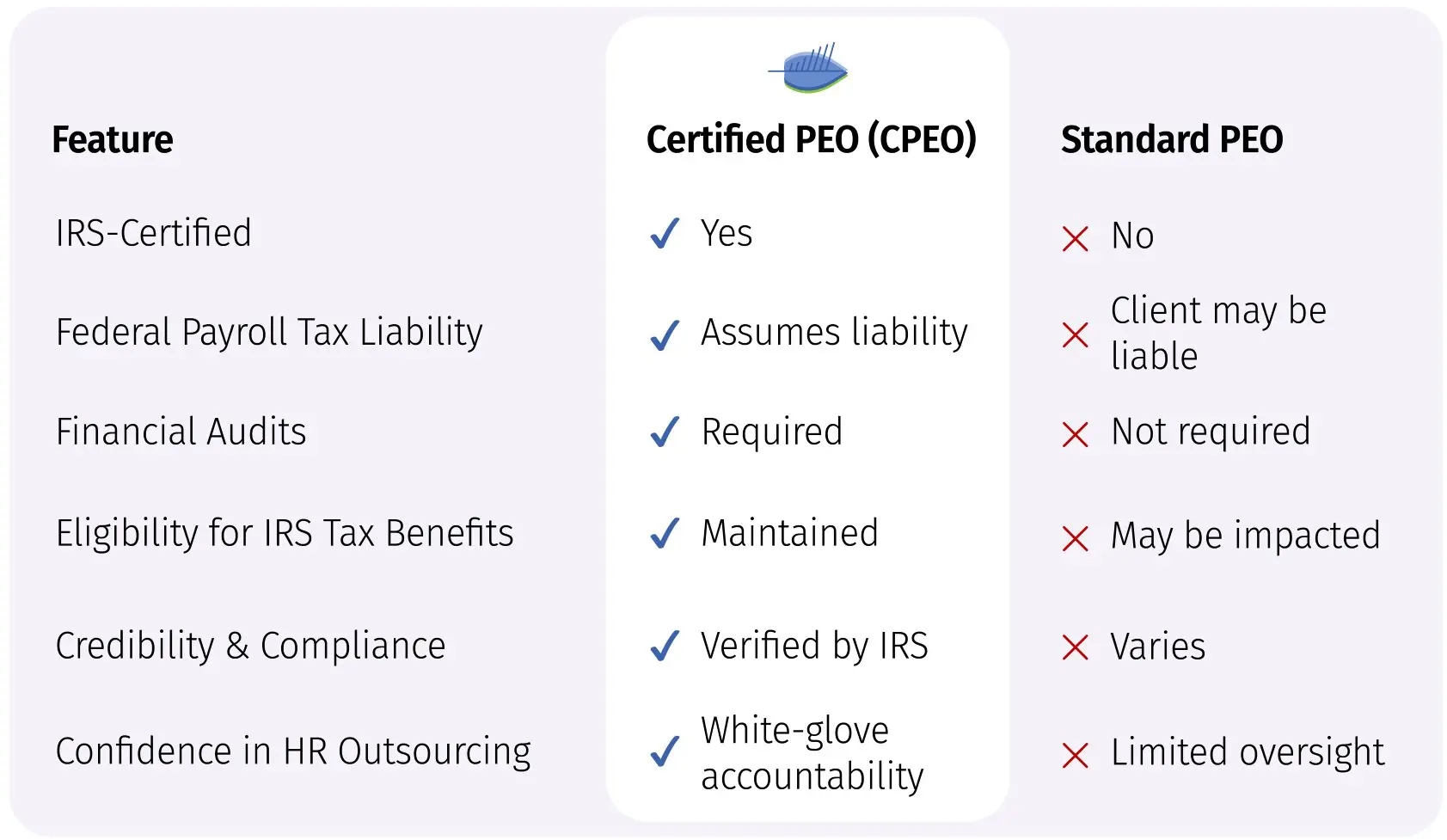
While both CPEOs and PEOs offer payroll and HR services, only Certified PEOs provide the assurance of IRS-backed compliance and liability protection.
Tax & Compliance Implications
For business owners, one of the biggest concerns when outsourcing HR is compliance especially when it comes to employment taxes.
A CPEO assumes full responsibility for collecting, reporting, and remitting federal payroll taxes. That means you’re not left financially liable if an error or late payment occurs.
Additionally, a CPEO helps:
- Preserve access to key tax credits
- Ensure accurate payroll tax filing
- Simplify reporting and reduce audit risk
- Maintain clean compliance records
These protections are particularly valuable for companies operating across multiple states or with complex payroll structures.
HR Services and Strategic Support
Both CPEOs and PEOs provide HR outsourcing support but a Certified PEO offers verified accountability and deeper service integration.
At AspenHR, our CPEO HR solutions are designed to meet the high expectations of emerging companies, private equity firms, and professional services teams.
Our offerings include:
- Robust health insurance plans
- Employee benefits tailored to attract and retain top talent
- Integrated 401k and retirement plans
- Secure, paperless payroll and tax filing
- Compliance expertise and white-glove service
Working with a Certified PEO like AspenHR means you’re supported by a team that’s not only experienced—but also accountable at every step.
When to Choose a CPEO Over a PEO
A Certified PEO is the right choice if:
- You value tax compliance and want to avoid unexpected liability
- You need to maintain tax credit eligibility
- You operate in multiple states or have complex payroll needs
- You’re scaling rapidly and want a verified HR partner
- You want white-glove service with built-in protections
For startups, high-growth companies, and firms undergoing audits or due diligence, the added confidence of working with a CPEO is a strategic advantage.
FAQ
What is the difference between a CPEO and a PEO?
A CPEO has IRS certification, assumes full federal employment tax liability, and complies with strict standards. A standard PEO does not carry the same legal or compliance protections.
What is a CPEO?
A Certified Professional Employer Organization (CPEO) is a PEO that has been officially certified by the IRS to meet specific tax, bonding, and audit requirements. This status provides added protection for clients and ensures higher compliance standards.